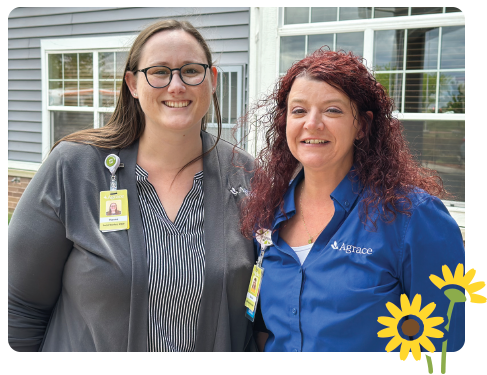
A game of tic-tac-toe led Hanna, social worker, and Karissa, nurse case manager, to a better way to communicate with their patient
In one of the long-term care facilities where Agrace’s Karissa Webb and Hanna Williamson see hospice patients, there was a puzzle. A patient named Dan* seemed trapped in silence due to a form of dementia.
“He couldn’t articulate his thoughts,” says Karissa, Dan’s nurse case manager. “He often repeated a few words or phrases, like ‘go to my room’ over and over. He couldn’t respond verbally to questions, and I could see this left him isolated. For a while, it seemed like that would be the way things would stay.”
Then Karissa noticed something intriguing.
“He was coloring quietly. He was calm and smiling. I’m not sure why, but I drew a grid for a game of tic-tac-toe,” she says. “We started playing, and at first, it was a casual couple of games. But it soon turned competitive. He was  surprisingly skilled and started winning. He started ‘schooling’ me—much to his amusement. And in that moment, we made a connection.”
Karissa told Hanna, Dan’s social worker, about the breakthrough, and they both wondered what else Dan could do.
When Hanna next visited, she also played tic-tac-toe with him. “I noticed that he would write down which one of us won the game. The other side of the paper we were using was a form. He saw this and started to fill it out with all the correct information. He even worked out the correct date,” says Hanna.
Karissa and Hanna soon developed a list of prompts and questions to help themselves, and others, connect more with Dan. The man who had once seemed unreachable had a real awareness of the world around him.
“Unlocking a way to communicate with him was incredible,” says Hanna. “It helped us all care for him better. It reduced frustrations for him and his caregivers. And people could see him as the smart person he was.”
“He began a new lease on life,” adds Karissa. “His daughter told me that he used to be an accountant and had a mathematical mind. After hearing about our breakthrough, she brought him puzzle books, some with complex math problems. He spent hours poring over them and clearly had a sharp mind. Even though it had been trapped away for a while, it was great to see that it was still vibrant and alive.”
*The patient’s name has been changed for privacy.
Agrace has launched a new Dementia Support service line to help families facing dementia—long before they need hospice care. See below for our upcoming “Learning to Live with Dementia” courses and more about the Agrace Adult Day Center in Madison.







 As you create a will, please consider making a legacy gift to Agrace to support dementia care. There is a clear need for better nonprofit care options in all the communities we serve.