Text Size

A

A

Reset Text

Questions? We're here for you.

(800) 553-4289


Teenage Patient Lives Her Final Weeks at Agrace, Thanks to Care for All Fund

teenage patient Meg at home with her cat

Meg and her cat

When Meg enrolled with Agrace Hospice Care last year at 17, she was being treated for her second brain tumor. Meg lived with her mother, Kelly, who cared for her while managing her own complex health issues.

“When they signed on to hospice, we weren’t sure if Meg’s prognosis was two weeks or two months,” says Michelle, her Agrace nurse case manager. “What was most important to Meg was her relationship with her mom and siblings—and her cats. She was relatively pain free for a lot of her time with us. ‘Symptom management’ became doing everything we could to keep her at home with her mom so she could see her siblings whenever she wanted.”

Michelle believes the care team’s support for Kelly was essential to Meg’s well-being: “We listened to her, were a sounding board for her and helped her with anticipatory grief. We were able to provide an outlet for her to just be a mom.”

‘They didn’t have anywhere else to go’

As Meg’s health declined, caring for her at home became increasingly difficult for her mother. Unable to work, Kelly could not afford to hire extra caregivers, and no other family members were able to move in to help. As a minor, Meg couldn’t move to an adult nursing home, either.

With financial assistance from Agrace’s Care for All fund, Meg moved to the Agrace Residence on our campus in Madison. The fees for her room and meals at Agrace were fully paid for by Care for All. This was the first time a minor lived at Agrace as a residential patient, but it was the best option to meet Meg’s care needs during the final weeks of her life.

michelle, agrace nurse case manager

Michelle, nurse case manager

Care for All funds usual cover only 30 days’ stay at the Residence, but an exception was made for Meg due to a lack of other appropriate care settings for her. At Agrace, she had access to hospice care staff around the clock to help her stay comfortable in her final weeks.

Michelle summarizes, “The biggest thing we did for Meg was to provide support for her mom when Meg needed more care—and they didn’t have anywhere else to go. Giving them somewhere her mom could be with her, the cats could visit and all the family could stop by whenever they wanted—that was huge for Meg and gave her some peace of mind. We were able to make accommodations so everyone could be there when Meg wanted, and make sure Meg was well cared for.

“They needed extra help—and we were it.”


illustration of orange slice and cinnamonCare for All is a charitable care fund supported by tax-deductible community donations to Agrace from caring people like you. Thank you!

 

winter foliage illustration with pine needles, orange, cinnamon, berries and pinconeLearning More about Living with Dementia


How many conversations have you had recently with friends whose parents, spouses or siblings are living with dementia? So many people are now caring for a loved one who has memory loss. It’s a stressful and confusing experience.

husband and wife hugging in their living room

That’s why Agrace is stepping up our dementia-support programming. There’s so much to learn and decide—long before a person is eligible for hospice care.

In January, we will begin a series of eight courses called Learning to Live with Dementia.” We developed this series for people (and their families) who are living with early- to mid-stage Alzheimer’s disease or other dementias—and need answers: What care will they need as the illness progresses? How will they access or provide this care? How will they make future care decisions?

If you’re facing dementia and are unsure of next steps, start with an Agrace Care Consultation. Our dementia support specialist can meet with you to offer information and guidance, including which courses in our “Learning to Live with Dementia” series may be helpful (there’s more detail below).

As Agrace builds the support families need to care for people with memory loss, we are relying on funding from some very generous donors who understand the impact of these services. I’ll share more news as our dementia-care efforts progress.

Lynne Sexten photoLynne Sexten
President & CEO


Learning to Live with Dementia courses are 45 to 60 minutes long, with time for your questions. They will be offered in person and virtually (online). You may attend one course or the whole series, depending on your needs. These courses and Agrace Care Consultations have modest fees. To learn more or register, please visit our dementia support web page or call (608) 276-4660.


From Big River to Great Lake: Agrace Extends Service to Milwaukee County in 2025

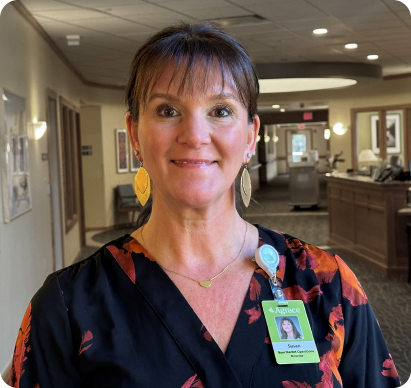
Susan Hirschfield, director of new market operations

Susan Hirschfield, director of new market operations

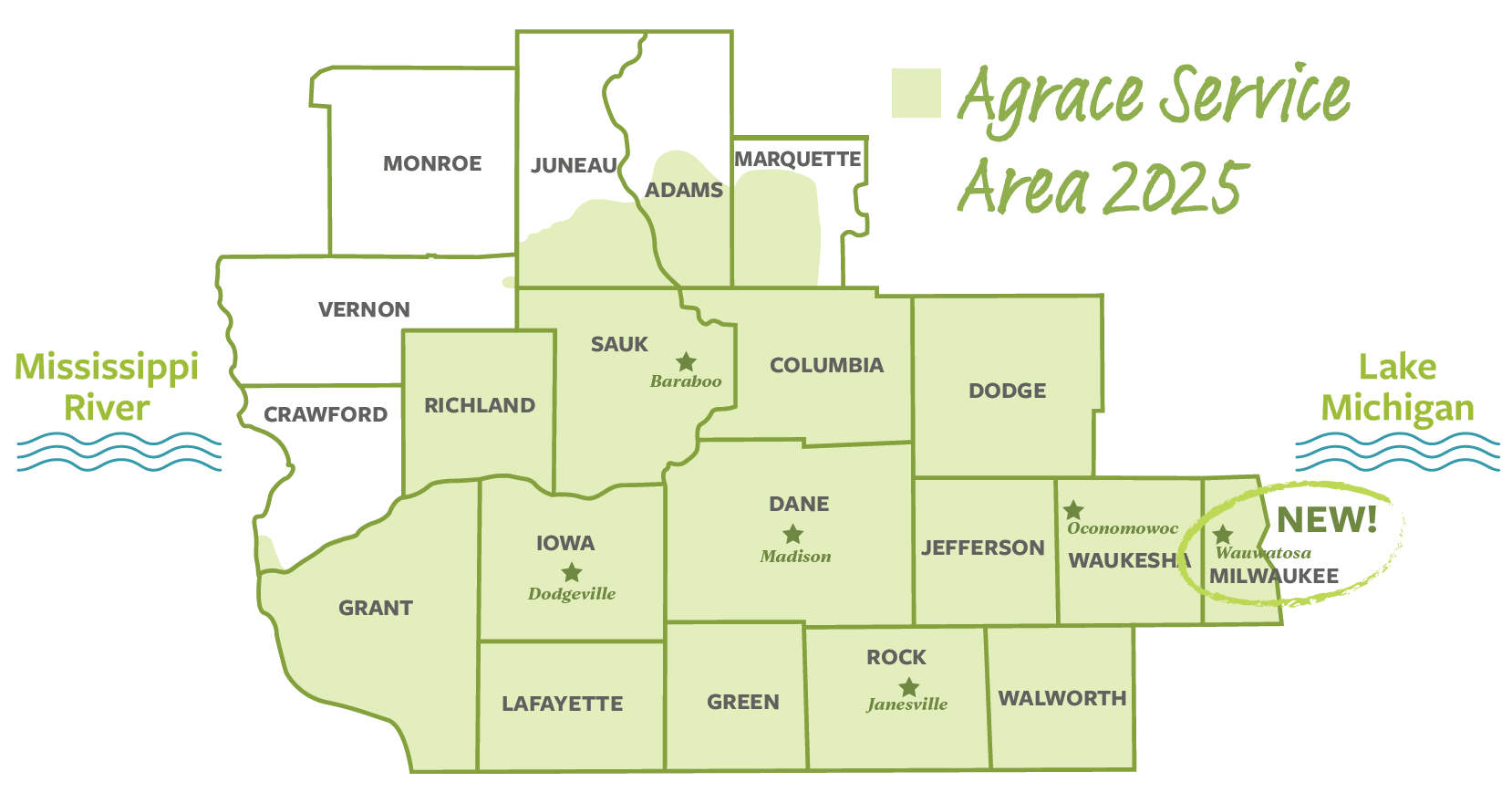
When Agrace begins to care for Milwaukee-area hospice patients in January 2025, we will serve southern Wisconsin all the way from the Mississippi River to Lake Michigan! Our newest hospice care team will serve patients throughout Milwaukee County from an office in Wauwatosa.

Having staff close by lets us reach patients quickly when an urgent care need arises. “We chose staff who know the area well, are already part of the community and understand the challenges as well as the local resources,” says Susan Hirschfield, Agrace’s director of new market operations. “We want all our staff to have that heart—the hospice heart. That level of compassion and commitment to serving patients and families.”

Agrace service area map for 2025 now including Milwaukee CountyWhy are we expanding eastward? We’re aiming to improve access to hospice care for Milwaukee-area patients, Susan says. “It’s important for us as a nonprofit hospice to establish ourselves in a market that has many for-profit hospices. We can care for patients who may be ‘underserved’ or in situations where providing care may be more challenging, and they can benefit from the opportunities Agrace can offer.”


“There are aspects of the care we provide that are exceptional,” Susan continues. “We bring patients, their families and care partners education and awareness, and help them plan for someone’s eventual death. We support them through that process.”

Spread the word! Agrace will first offer hospice care in Milwaukee County, adding other services in the future. If you have family and friends who live in Milwaukee and its suburbs, please share this news with them so they can ask for Agrace when end-of-life care is needed.

illustration of twig with red berries

To request Agrace Hospice Care in Milwaukee County, please call (800) 930-2770.


Light Up a Life for Agrace this Holiday Season

light up a life memorial display Who lights up your life? You can honor them by supporting Agrace’s Light Up a Life campaign before year-end. Names of those you honor become part of a seasonal memorial display in Agrace’s Madison and Janesville lobbies, representing the joy our loved ones bring to our lives.

To be part of the display, use this form and select “I’m donating to Light up a Life.” Your donation will help sustain Agrace’s mission of compassionate care by helping us fund programs and services that are not covered by Medicare or other insurance.

Donate to Light Up a Life
 

jessie shiveler headshot

Jessie Shiveler

Kinder, Gentler Words for a Grieving Person

By Jessie Shiveler, community grief manager, Agrace Grief Support Center

It’s common to feel unsure about how to support someone who is grieving a death. We worry that whatever we say may sound wrong to someone who is already hurting. Here are some supportive ways to offer comfort (and some words to avoid) when someone you know is grieving.

Instead of: “They [the person who died] wouldn’t want you to be sad.”
Try: “It makes so much sense that you’re feeling this way.” Every emotion in grief is valid and common. Sadness is a natural response to a death; it’s OK for a grieving person to be sad.

Instead of: “You need to get out of the house.”
Try asking: “What do you think helps the most right now?” You may think a grieving person needs to get out of the house, but that may not actually be what helps them.

Instead of: “Let me know if I can do anything.”
Try offering something specific: “I am heading to the grocery store later. What can I grab for you?” Don’t put the burden on the grieving person to come up with a to-do list; suggest how you are willing to help.

Instead of: “Your kids need you to be strong.”
Try: “I can see it’s hard to parent and grieve at the same time. Can I take your kids for the afternoon on Saturday so you can focus on yourself?” Adults who are parenting and grieving need time, space and support to focus on their own grief so they can best support their kids.

illustration branch with red berriesInstead of: “Everything happens for a reason.”

Try: “This is so unfair. I’m sorry you’re going through this.” Unless the grieving person says “Everything happens for a reason,” they may not believe that to be the case, and saying it can alienate them.

Questions about grief support and grieving? Contact the Agrace Grief Support Center at (608) 327-7110.

Find more tips on what to say (and what not to say) to grieving people here. Many of Agrace’s grief resources are also available in Spanish.


illustration of pine cone and pine needlesAsk Agrace for Grief Education at Work or School

When we encounter grieving people in professional settings like work, school or community groups, it’s hard to know the best ways to be appropriately supportive and helpful.

Let Agrace help you build these skills. We offer grief education programs to prepare you to express sympathy, be supportive of a colleague or client, or cope with a death that affects many people at a workplace, school or community organization.

Our grief support specialists can come to your location and offer guidance for your specific need.

Learn about Grief Education Programs
 

 screenshot of the agrace website pointing out the spanish language button in the top right corner¿Hablas español? You Can Now See Agrace’s Website in Spanish

Would you buy an important product if its user instructions were in a language you couldn’t read—or in badly translated English?

Now imagine having to choose a key health service that way. Having health information in your preferred language is vital, but most instant translation apps are not reliable enough for medical content.

After months of research and testing, Agrace is now using a high-quality website translation tool we trust. You can instantly switch between English and español on this site by clicking in the upper right corner.

We plan to refine the translation over time and explore adding languages to help more potential patients, volunteers and donors learn about our services in their preferred language.


Help Agrace Patients Feel Respected, Important, Heard

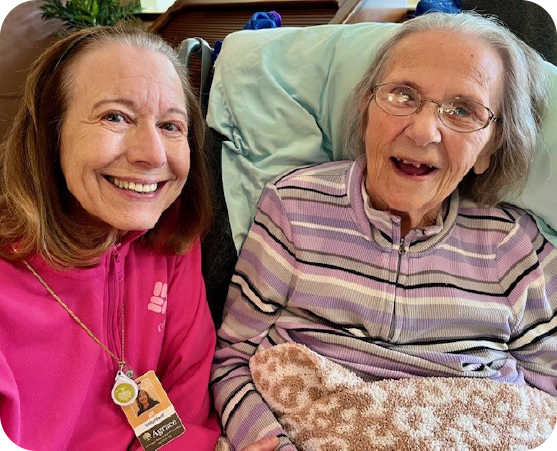
Volunteer Jill (L) with Barbara

Volunteer Jill (L) with Barbara

As an Agrace volunteer, you can choose visits that match your skills and free time. One of the most important parts of this work is helping patients feel respected and heard. Whether you are sitting with them and reading the newspaper or helping them with small tasks around their home, these moments remind patients they are important and cared for. Before you start volunteering you will receive the training you need to feel supported and ready for your visits.

illustration of pine cone and pine needlesThere are patients in your area who would benefit from your presence. Join us today and start making days brighter for hospice patients in your town. To get started, visit the link below or call (608) 327-7163.

Learn more
 

Bucky Badger Cheers a Superfan at Agrace

badger bob with bucky visitingAt Agrace’s Hospice Memory Care Suites in Madison, a lifelong UW fan known as “Badger Bob” had a room adorned with Badgers memorabilia. Thanks to his care team, Agrace’s Wish program and Wisconsin Athletics, Bob got a personal visit from Bucky Badger himself!

Bucky made an electric 30-minute visit, dancing around to “If You Want to Be a Badger.” He presented Bob with a Wisconsin Badgers zip-up jacket and a signed ball for his collection. Bob’s brother, James, said, “You could see it all on his face. Agrace did it again!”


Grief Support Offered for Young Adults

illustration of leaves and berriesYoung adults (18 to 30-ish) are invited to an Agrace grief support group designed just for them. It’s offered the second Wednesday of each month from 6 p.m. to 7:30 p.m., alternating between virtual and in-person meetings at the Agrace Grief Support Center in Fitchburg. Pre-registration is required before each session. The $20 per-session fee can be lowered or waived, if needed. Learn more at the link below or call (608) 327-7110.

Learn more

Agrace staff packing Thanksgiving meals to be delivered to patients

350+ Thanksgiving Meals Delivered

It’s hard enough to make a whole holiday meal when you’re feeling your best, let alone when someone in the family is very ill or dying. On November 26 and 27, Agrace staff delivered 350+ Thanksgiving meals to our patients.  The meals are prepared by Agrace’s kitchen staff, packed and delivered by staff volunteers and paid for by community donations to the Agrace Foundation. illustration of orange slice and cinnamon